A complete guide for Pakistani farmers — from water source to the right HP, without the guesswork.
By Hikmat Pump Pvt Ltd • Islamabad, Pakistan
It is peak irrigation season. Your neighbours’ crops are drinking well. Yours are not — because the pump was never matched to your land in the first place.
The truth most dealers never tell you? The pump itself is rarely the problem. The mismatch is. A submersible pump built for a 50-foot boring will struggle and burn at 200 feet. A centrifugal pump perfect for a canal lifts almost nothing from a tubewell. And a motor too small for your acreage will run non-stop, waste electricity, and quit by the second season.
This guide gives you exactly what you need to walk into any pump shop in Pakistan and know precisely what to ask for.
Start Here: 4 Questions to Answer Before Buying Any Farm Pump
Choosing the right agricultural water pump is not about brand names or price tags. It is about matching the machine to your land. Answer these four questions first — they cut your decision-making time in half.
1. What is your water source?
This is the single most important question. Different sources need fundamentally different pump types.
- Tubewell or deep boring (50 ft or deeper) — requires a submersible pump that sits inside the boring.
- Canal, river, or open water channel — a centrifugal surface pump handles this efficiently.
- Shallow open well or dugwell — a solar pump or small submersible works well here.
- No fixed source, seasonal water body — a portable diesel or petrol pump gives flexibility.
2. How much land do you irrigate?
Land size determines how much water your pump must deliver per hour — what engineers call flow rate. Roughly: a 5-kanal plot needs around 1.5 to 2 HP. Push to 3 acres and you are looking at 3 to 5 HP. Scale to 5 acres or more and 7 HP and above starts making sense. Section 3 covers this with a visual chart.
3. What irrigation method do you use?
Flood irrigation needs high flow but low pressure. Drip and sprinkler systems need lower flow but consistent pressure. Your pump must match both the volume and head pressure requirements of your specific method.
4. What power is available on your farm?
Reliable three-phase supply, single-phase only, or no grid at all? This question eliminates half your options immediately — and Section 4 covers the electric versus solar decision in full.
Answer these four questions and the right pump category selects itself. Everything else is just specifications.
Types of Farm Irrigation Pumps in Pakistan — Matched to Your Water Source
Pakistan’s agricultural landscape ranges from the flood plains of Punjab to the terraced farms of KPK. The pump that works in Sheikhupura is not the pump that works in Chakri. Here is a simple breakdown.
Submersible pump — the go-to for deep borings
A submersible pump lives underwater inside your tubewell or boring. Because it pushes water upward from below rather than pulling from above, it handles depth with ease — anywhere from 50 to 400 feet and beyond. If your boring is 200 feet deep and you are extracting groundwater for farm irrigation, a submersible water pump is your answer.
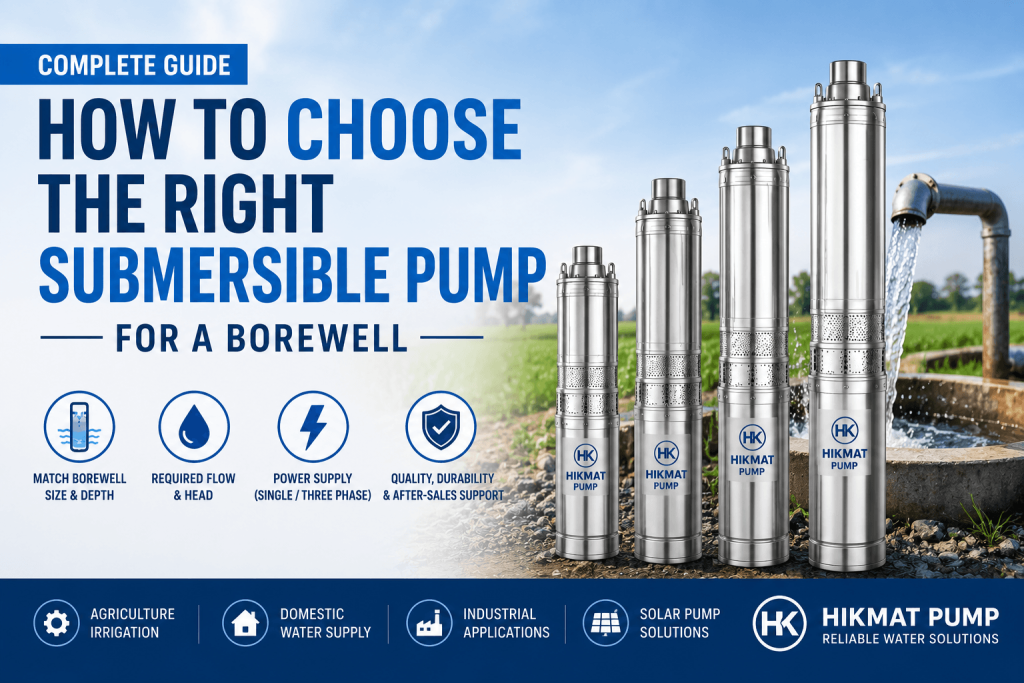
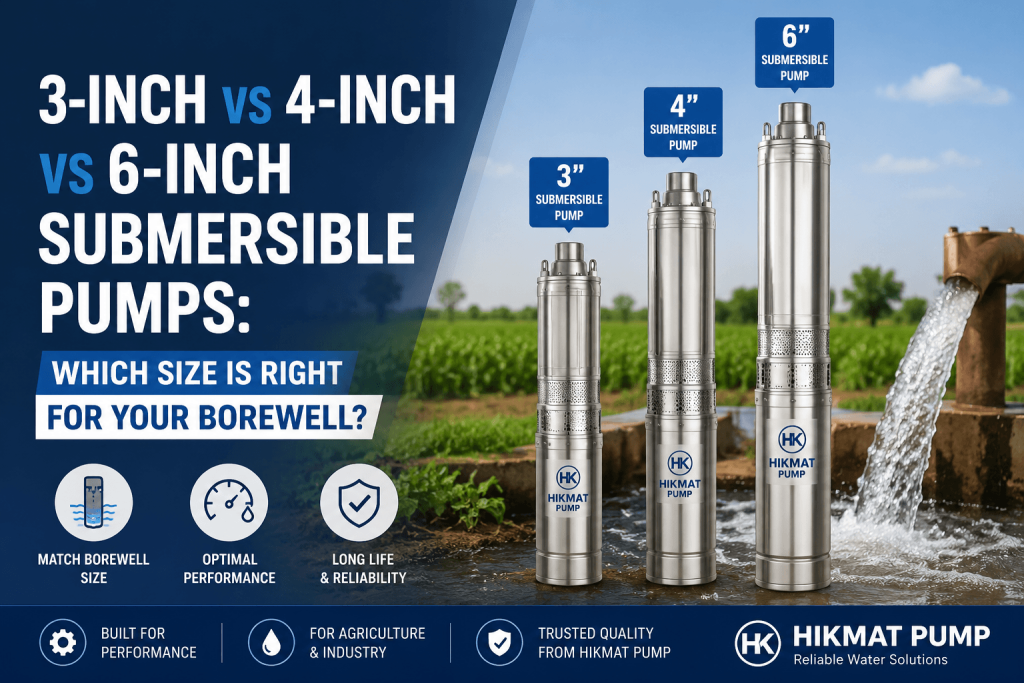
Submersible pumps come in 2-inch, 3-inch, 4-inch, and 6-inch casing sizes. A 4-inch submersible motor will not fit into a 3-inch borehole. Match the casing size before you commit.
Centrifugal (surface) pump — built for open water
If your water source is a canal, river, or nullah, a centrifugal pump is faster, cheaper, and perfectly sized for the job. It sits above ground, pulls water through a pipe, and delivers it through your irrigation channels. It cannot handle depth — but for surface water access, nothing beats it on flow rate.
Solar pump — the long game
Solar irrigation pumps are no longer a novelty in Pakistan. For farms with unreliable grid supply most of rural Punjab and KPK — a solar pump eliminates your biggest running cost: electricity. The upfront investment is higher, but there is no monthly bill eating into your margins.
A practical reference point: a pump drawing water from 200 to 250 feet on a 2 to 3 HP motor typically runs on 4 to 6 solar panels in the 300 to 400 watt range. For a deeper boring at 280 to 300 feet needing more flow, you are looking at 5 panels at around 400 to 440 watts each — totalling approximately 2,000 to 2,200 watts. Your installer must size this properly for your specific depth and flow requirement.
Diesel / petrol pump — for when the grid disappears
Where there is no electricity and no solar budget, a diesel or petrol pump keeps things moving. A practical option for remote areas or seasonal fields — not the most efficient long-term, but reliable when nothing else is available.
Farm Pump Comparison
| Pump Type | Best Water Source | Water Access | Irrigation Method | Power Source |
|---|---|---|---|---|
| Submersible | Tubewell / Deep boring (50 ft+) | Deep groundwater | Flood, drip, sprinkler | Grid electric / Solar |
| Centrifugal | Canal / River / Open well | Surface or shallow | Flood & furrow | Grid electric / Diesel |
| Solar Pump | Tubewell / Boring (any depth) | Deep or shallow | Drip & sprinkler | Solar panels |
| Diesel Pump | Open well / Canal | Surface water | Flood irrigation | Diesel / Petrol |
How Much HP Does Your Farm Actually Need?
HP = HorsePower — is the number farmers focus on most, and understandably so. But more HP is not always better. An oversized motor wastes electricity every hour it runs. An undersized one burns out before the season ends. The goal is the right HP for your land and your water depth.
The chart below is a practical reference built for Pakistani farming conditions.
Recommended Pump HP by Farm Size — Pakistani Irrigation Conditions
- 5 kanal: Approximately 1.5–2 HP
- 3 acres: Approximately 3–5 HP
- 5 acres or more: 7 HP and above
A few real-world notes that regularly come up:
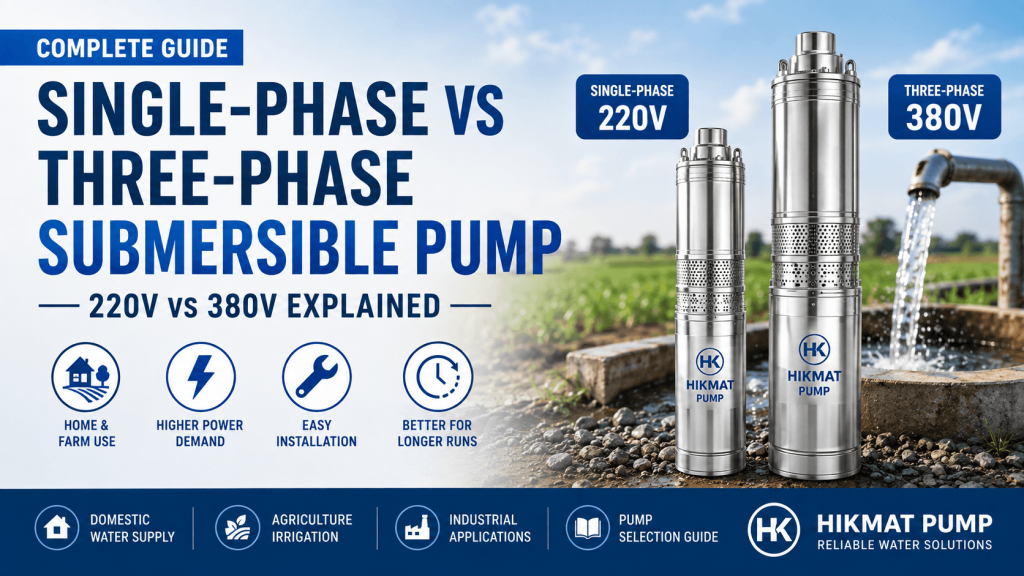
- Single-phase electricity (220V) comfortably runs motors up to 2 HP. Anything above, and three-phase supply becomes a practical necessity.
- A pump running at 160 to 200 volts (low voltage) will underperform and overheat. If voltage fluctuation is common on your farm, a voltage stabilizer is not optional — it is essential.
- A 4-inch submersible motor at full load typically consumes 2.5 to 4 electricity units per hour depending on HP — factor this into your seasonal running cost.
Quick Field Example
A farmer in Chakri, Rawalpindi with 2 acres of wheat and a 180-foot boring would typically need a 3 HP submersible pump on a 4-inch casing. On solar, this translates to roughly 4 to 5 panels at 370 to 400 watts each to run during peak sun hours.
Electric vs Solar Farm Pump — Which Makes More Sense in Pakistan Today?
This is the question on every kisan’s mind right now — and rightfully so. Pakistan’s electricity tariffs have risen sharply, and load-shedding in rural areas remains a real operational risk. The answer depends on your farm’s profile, not a blanket recommendation.
Solar irrigation pumps have moved well past the pilot stage in Pakistan. ICIMOD — the International Centre for Integrated Mountain Development — in collaboration with the Pakistan Agriculture Research Council (PARC) under the HI-AWARE initiative, piloted solar-powered irrigation systems in Chakri village, Rawalpindi, in the Soan River basin. The outcome: farming in Chakri became measurably more sustainable, electricity dependency dropped, and the model drew attention from government officials and researchers across the Rawalpindi region. This was a working farm, in conditions that directly mirror what many Pakistani farmers face daily.
A peer-reviewed study published in the Pakistan Journal of Humanities and Social Sciences (2024) further surveyed 141 farmers in Union Council Ganj, Chakri, Rawalpindi — same Soan River basin. It found strong willingness to adopt solar-driven drip irrigation systems, especially among farmers dealing with unpredictable electricity supply and shrinking groundwater. Both studies point the same direction: for Pakistan’s rainfed and semi-arid zones, solar is becoming the smarter long-term play.
Electric vs Solar Decision Matrix
| Your Situation | Best Choice | Key Benefit | Note |
|---|---|---|---|
| Reliable 3-phase grid | Go Electric | Lower upfront cost | Running cost is ongoing |
| Frequent load-shedding | Go Solar | Zero running cost | Higher upfront investment |
| Remote / off-grid farm | Go Solar | No grid needed | Consistent year-round |
| Tight budget, grid available | Go Electric | Manageable entry cost | Budget-friendly start |
One thing both options share: motor quality matters regardless of power source. A poorly wound motor underperforms on grid electricity just as much as on solar.
5 Things to Verify Before You Buy a Farm Pump in Pakistan
You know your pump type and your HP range. Before money changes hands, run through this checklist. These are the details that separate a pump serving you for eight to ten seasons from one needing a rewind by the third.
| What to Check | Why It Matters |
|---|---|
| Motor winding | Copper winding handles voltage fluctuations and outlasts aluminium alternatives by years. |
| Casing size match | Confirm your borehole diameter first. A 4-inch pump will not physically enter a 3-inch casing. |
| Phase compatibility | Check whether your farm has single-phase or three-phase supply. This alone narrows your motor options significantly. |
| Rewindable motor | In areas without service centres, a rewindable motor is invaluable — local electricians can restore it without full replacement. |
| Warranty & after-sales | Ask what is covered, for how long, and who is responsible when something goes wrong in the field. |
One practical note rarely mentioned: if a pump ever gets stuck inside a deep boring — which happens when the casing shifts or debris enters — recovery is possible but requires a specialised pump-pulling team. Before any installation, ensure the boring casing is in good condition and lower the pump with a proper safety rope or chain alongside the delivery pipe. A simple precaution that saves enormous headache later.
The Right Pump Starts With the Right Decision
The right farm pump is not the highest HP or the lowest price. It is the right match — and now you know exactly how to find it.
Water source → Land size → Power available → Pump type → Right HP
Follow that sequence and you will not go wrong. Pakistan’s farms cannot afford guesswork when the fasal is on the line. If you still have questions about your specific boring depth, land size, or power setup — Connect with our expert team, Hikmat Pump is here to help you think it through.
Hikmat Pump Pvt Ltd — Built for Pakistan. Built to Last.
Made in Pakistan • Agricultural • Industrial • Submersible • Solar Water Solutions